Rajasthan's Time-of-Day (ToD) Electricity Tariff Shift: Why Daytime Solar Now Saves Commercial Users Even More
Rajasthan's New ToD Tariff Means Your Solar Panels Just Got More Relevant
If you run a shop, office or factory in Jaipur, you may have noticed talk of Time-of-Day (ToD) electricity tariffs entering Rajasthan's power billing structure. It is a genuine shift in how discoms price electricity, and it changes the conversation around rooftop solar in a way worth understanding before your next renewal or expansion decision.
What Time-of-Day tariff actually changes for your electricity bill
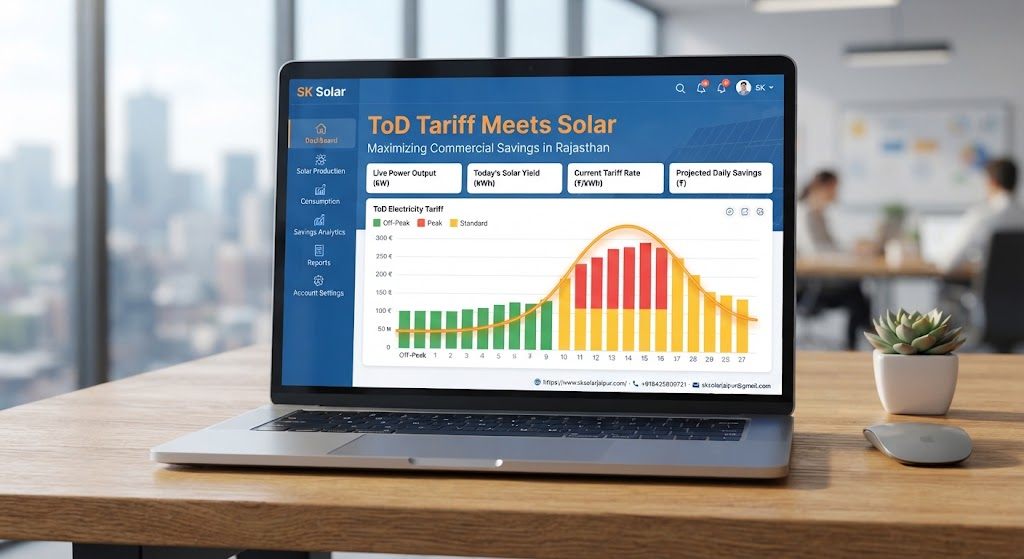
Under a ToD structure, the rate you pay per unit depends on the hour you consume power, not just the total units used. Typically, there are peak hours where rates are higher and off-peak hours where they are lower. For businesses with heavy daytime operations, this means your bill is now more sensitive to when your machines, AC units or lighting draw the most load.
Why solar generation lines up with peak daytime hours
Solar panels obviously generate power only during daylight, roughly between morning and early evening. In many ToD structures, a chunk of that window overlaps with periods discoms classify as peak or high-rate hours for commercial consumers. That overlap is the practical reason ToD tariffs are worth discussing alongside a rooftop solar decision - self-generated solar power used during the day offsets exactly the hours that may now cost more under the new structure.
Who this matters most for
Shops, offices, hotels, hospitals and factories that operate primarily during the day stand to gain the most attention here, simply because their consumption pattern is already daytime-heavy. Warehouses and units with significant night-shift or 24-hour loads will see a different picture, since solar cannot offset consumption after sunset without battery storage.
What SK Solar actually looks at before recommending anything
We do not push a standard system size to every enquiry. Before recommending a rooftop solar system under a ToD-aware approach, our team reviews your actual load curve, existing tariff category, roof orientation and available area. Real savings depend on all of these factors together, not on a headline percentage.
My take: if your business already runs mostly in daylight hours - a shop, office, school or single-shift factory - it is worth getting your load profile reviewed against the ToD structure sooner rather than later, since the tariff shift only strengthens the case for daytime solar self-consumption. If you run heavy night-shift operations, a straight ToD-driven solar pitch will not tell the full story for you, and that is exactly the kind of nuance a proper site assessment from SK Solar is meant to catch before you commit to a system size.
🌐 https://www.sksolarjaipur.com/ · 📞 +918426809721 · 📧 dinesh@designanddevelopment.in
Planning rooftop solar in Jaipur?
Get a site survey and a system sized to your roof and your bill from the SK Solar team.
Request a free assessment