Blog
Accelerated Depreciation (AD) and Solar ROI: How Indian Commercial Enterprises Write Off 40% Capital Outlay in Year One to Slash Corporate Tax and Unlock Immediate Operational Savings
17 Aug 2026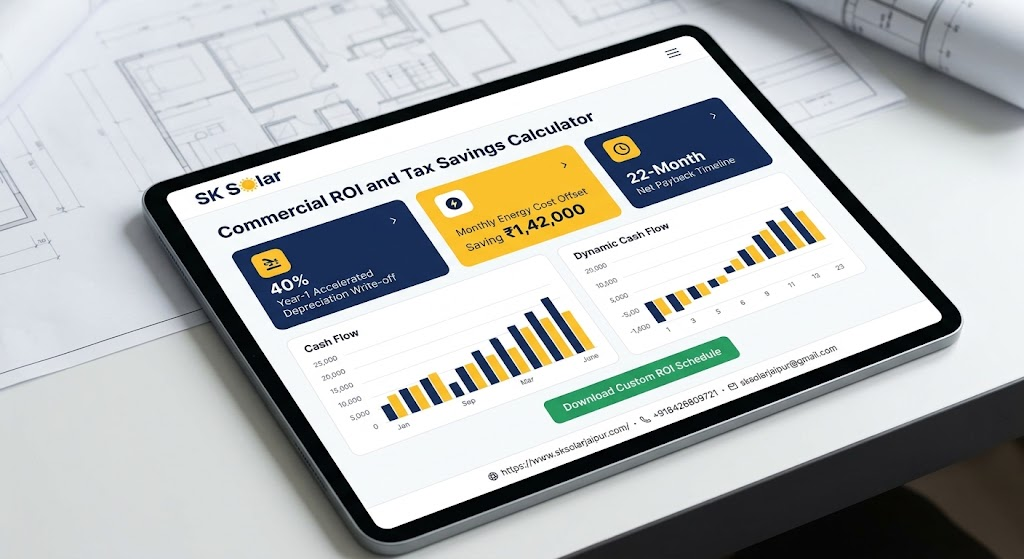
The CFO Blueprint: Unlocking 40% First-Year Tax Write-Offs and Long-Term Power Savings with Commercial Rooftop Solar
Most commercial property owners and industrial decision-makers view rooftop solar primarily as a sustainability initiative. While reducing your corporate carbon footprint is valuable, the immediate financial upside of a captive solar installation makes it one of the most attractive capital expenditures a business can make. By taking advantage of existing fiscal depreciation benefits alongside deep reductions in utility tariffs, companies can recover their initial capital outlay far faster than traditional machinery investments while locking in predictable energy costs for decades.
Understanding the Year One Accelerated Depreciation Advantage
Under Section 32 of the Indian Income Tax Act, commercial and industrial enterprises investing in captive solar power plants can claim Accelerated Depreciation at a rate of 40% on their solar asset. If your solar installation is commissioned and operational for at least 180 days within the fiscal year, your business can claim the full 40% depreciation allowance against its taxable profits in Year 1. Even if commissioned for fewer than 180 days before the fiscal close, a 20% depreciation claim applies immediately, with the remaining balance rolling over to the following financial period. This statutory tax shield effectively offsets a substantial portion of the project capex during the first twelve months of operation.
Displacing Peak Commercial Tariffs with Predictable Self-Generation
Commercial and industrial electricity rates from state utility providers often sit in top-tier billing brackets and carry automatic annual fuel-surcharge escalation clauses. Every unit of electricity your rooftop generates is a unit you do not purchase at peak utility tariffs. A properly engineered solar EPC installation typically reduces daytime grid consumption by 70% to 85%. Because solar photovoltaic systems carry zero ongoing fuel costs, your per-unit cost of daytime electricity drops to a predictable, rock-bottom level for the entire 25-year design life of the system.
The Compounding Financial Timeline from Capex to Pure Positive Cash Flow
When you combine the corporate tax shield from accelerated depreciation with monthly recurring electricity bill savings, the financial trajectory of commercial solar becomes compelling. In standard commercial scenarios across Rajasthan, the net capital outlay achieves complete breakeven within 24 to 36 months. Once this milestone is passed, the solar power plant acts as an on-site utility that delivers virtually free electricity directly to your bottom line. Surplus energy generated during weekend or holiday shutdowns can also be exported back to the grid through net-metering mechanisms, generating utility credits that offset non-solar billing hours.
Why Precision EPC Engineering Determines Your True Return on Investment
A solar financial model is only as dependable as the engineering behind it. Maximum financial yield requires rigorous structural roof assessments, premium high-efficiency Tier-1 PV modules, properly matched inverters, engineered AC and DC distribution panels with comprehensive surge protection, and compliant copper-bonded earthing infrastructure. Sub-par balance-of-system components or sloppy installation work lead to generation clipping, unplanned maintenance downtime, and premature degradation that erodes your projected return. Working with a dedicated, end-to-end solar EPC partner like SK Solar ensures that your plant is built to perform consistently under high-temperature conditions while meeting all DISCOM compliance standards.
My Take on Making the Commercial Solar Move
If your business pays substantial corporate income tax and spends upwards of ₹50,000 monthly on commercial grid electricity, waiting to go solar simply leaks revenue. If your available capital is committed to core operational growth, explore structured solar debt or CAPEX financing where your monthly power savings comfortably exceed the loan installment. If you have cash reserves, deploying direct capital into an owned rooftop solar asset delivers an internal rate of return (IRR) that routinely outpaces standard corporate financial instruments. Reach out to the SK Solar engineering team in Jaipur to model your facility exact tax shield and payback window before the current fiscal year wraps up.
🌐 https://www.sksolarjaipur.com/ · 📞 +918426809721 · 📧 sksolarjaipur@gmail.com