Blog
Bypass Diodes & Hotspot Protection: How a Single Shaded Cell (One Leaf, One Bird Dropping) Doesn't Kill Your Entire Solar Array
20 Aug 2026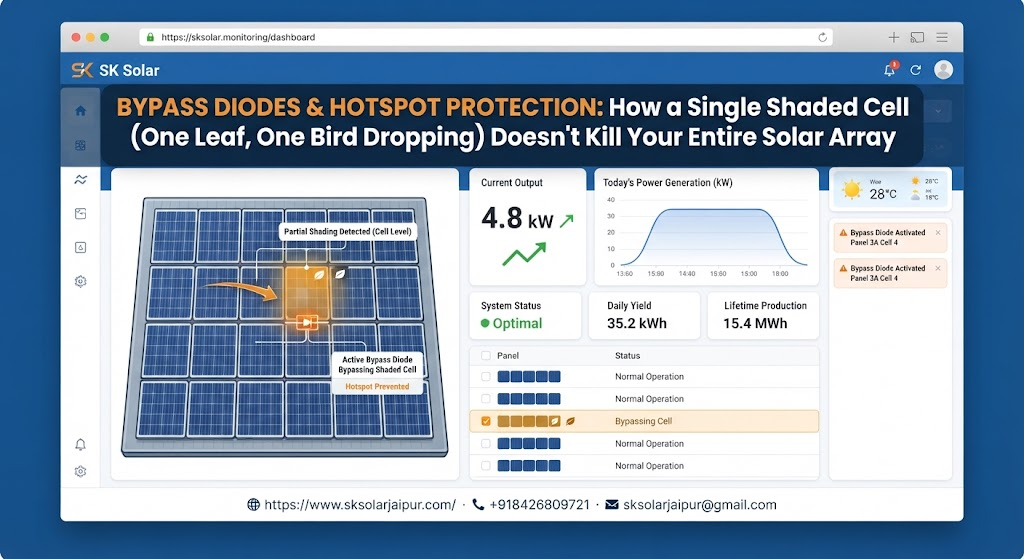
Why One Shaded Solar Cell Shouldn't Take Down Your Entire Rooftop System
If you've ever worried that a stray leaf, a layer of dust, or a bird dropping on one corner of your solar panel could crash your whole system's output, you're asking a smarter question than most first-time solar buyers. The answer lies in a small, unglamorous component called a bypass diode, and understanding it can help you tell a well-engineered solar panel apart from a cheap one.
What Actually Happens When a Leaf Falls on Your Panel A solar panel is made up of cells wired together in strings. When one cell in a string gets shaded, it stops generating current but still sits in the electrical path of the cells around it. Without protection, that one dark cell would act like a bottleneck, dragging down the output of the entire string, and in worse cases, heating up dangerously as the other cells push current through it. This heating effect is known as a hotspot, and over months or years it can permanently damage the cell.
The Bypass Diode: A Small Component With a Big Job Bypass diodes are wired across sections of the panel specifically to handle this scenario. The moment a cell or group of cells gets shaded, the diode opens an alternate path for current to flow around that section, instead of through it. The result is that the rest of the panel keeps producing power close to normal, and the shaded section is protected from overheating. It's a passive, automatic safeguard, no software or monitoring required.
Why This Matters More in Jaipur's Dusty, Bird-Heavy Environment Rajasthan rooftops deal with a fair amount of dust accumulation, occasional bird activity and seasonal debris. Partial shading isn't a rare edge case here, it's a normal part of owning a rooftop solar system. This makes bypass diode quality and proper panel construction genuinely relevant to how your system performs and how long it lasts, not just a theoretical engineering footnote.
What to Ask Before You Buy Any Solar Panel Most sales conversations focus on wattage and price per panel. Fewer buyers ask about panel-level protection, junction box quality, or how the system is engineered to handle real-world imperfect conditions like partial shading, dust, and temperature swings. These details don't show up on a spec sheet headline, but they influence how consistently your system performs over its lifetime.
My take: if you're evaluating solar quotes and everyone is quoting similar prices, this is exactly the kind of detail worth asking about directly, don't just compare panel counts or headline wattage. A vendor who can explain how their panels handle shading and hotspot protection is usually a vendor who's thought through the engineering, not just the sale. At SK Solar, we're happy to walk you through these specifics for your specific rooftop, whether it's a home, shop, factory or farm.
🌐 https://www.sksolarjaipur.com/ · 📞 +918426809721 · 📧 sksolarjaipur@gmail.com