Blog
MC4 connector quality: the tiny plug that decides if your Jaipur rooftop solar system leaks power or lasts 25 years
16 Sept 2026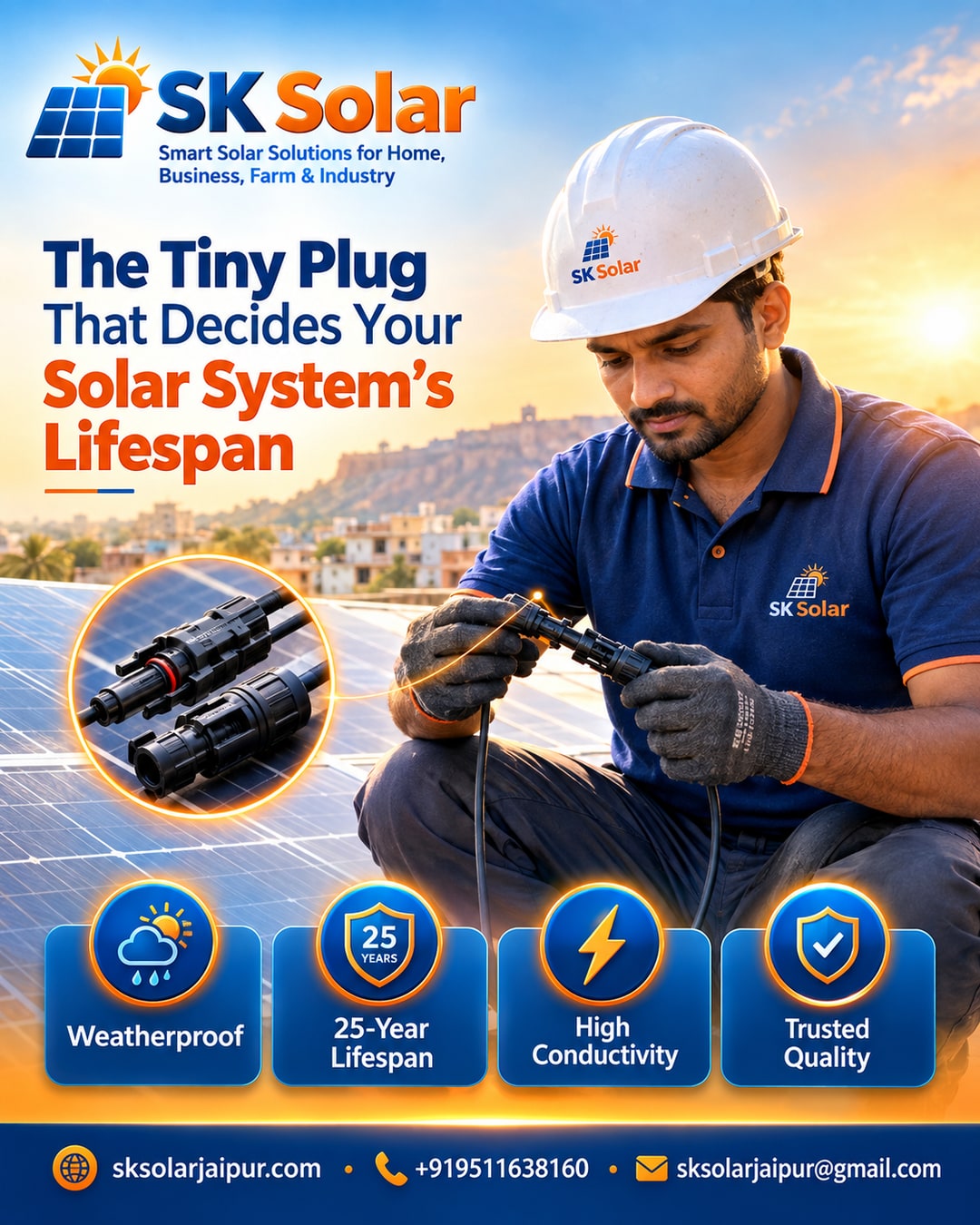
The Tiny Plug That Decides If Your Solar System Lasts 25 Years
When people shop for rooftop solar, they compare panel brands, wattage and price per unit. Almost nobody asks about the small plastic-and-copper connectors that actually join those panels into one working system. That is a mistake, because MC4 connectors are one of the most exposed, most overlooked parts of any solar installation - and their quality has a real effect on how your system performs over its lifetime.
What an MC4 connector actually does Every solar panel has two leads coming out the back, and those leads plug into the next panel's leads using MC4 connectors - locking, weatherproof plugs designed to carry DC current safely between panels and into the wiring that runs to your inverter. There can be dozens of these connection points across a single rooftop system. Each one sits outdoors, permanently, for the full 25-year life of the system.
Why Jaipur's climate makes this a bigger deal Rajasthan rooftops see intense summer heat, heavy dust loading, and monsoon humidity in the same year. Connectors rated for real outdoor use are sealed to an IP68 standard, meaning they resist dust and water ingress even under sustained exposure. A connector that is not properly rated, or one that was crimped incorrectly during installation, can develop tiny gaps over time. Moisture gets in, resistance builds up at the joint, and the connection starts to heat up under load - sometimes enough to cause visible arcing or a melted connector housing in extreme cases.
The quiet performance loss nobody notices Most failing connectors do not cause a dramatic shutdown. Instead, they cause a slow, small loss of output at that junction - a few percent here, a loose contact there - that is easy to miss unless someone is actively monitoring system performance. Over years, these small losses add up, and by the time a homeowner or shop owner notices their generation feels lower than expected, tracing it back to a single bad connector deep in the wiring can be difficult without proper diagnostics.
What proper crimping and matched connectors actually involve Good installation practice means using connectors from a compatible, correctly rated manufacturer, crimping them with the right tool and pressure so the copper contact is fully seated, and never mixing connector brands within the same string, since slightly different tolerances can affect the seal. It sounds like a small technical detail, but it is exactly the kind of detail that separates a system that runs quietly for 25 years from one that develops mysterious underperformance around year eight or nine.
Why this belongs in your installer conversation When you are evaluating a solar EPC company in Jaipur, it is worth asking not just about panel brand and inverter brand, but about their connector specification and crimping process as part of quality control. It is a fair question, and a good installer should have a clear answer rather than a shrug. SK Solar includes connector quality and IP68-rated weatherproofing as a standard checklist item across residential, commercial, industrial and farm installations - because reliability is built at the smallest level of the system, not just on the spec sheet of the panel.
My take: if you are comparing solar quotes purely on panel wattage and headline price, you are missing half the picture. Ask your installer directly what connector brand they use and how crimping quality is checked - if they cannot answer clearly, treat that as a warning sign, not a minor detail. For a system you expect to run for 25 years, the plugs holding it together deserve as much scrutiny as the panels themselves.
🌐 https://www.sksolarjaipur.com/ · 📞 +918426809721 · 📧 sksolarjaipur@gmail.com