Blog
the psychology and operational workflow of how sk solar certified master electricians execute clean wire management and precision dc/ac conduit routing on a high-temperature industrial rooftop
13 Aug 2026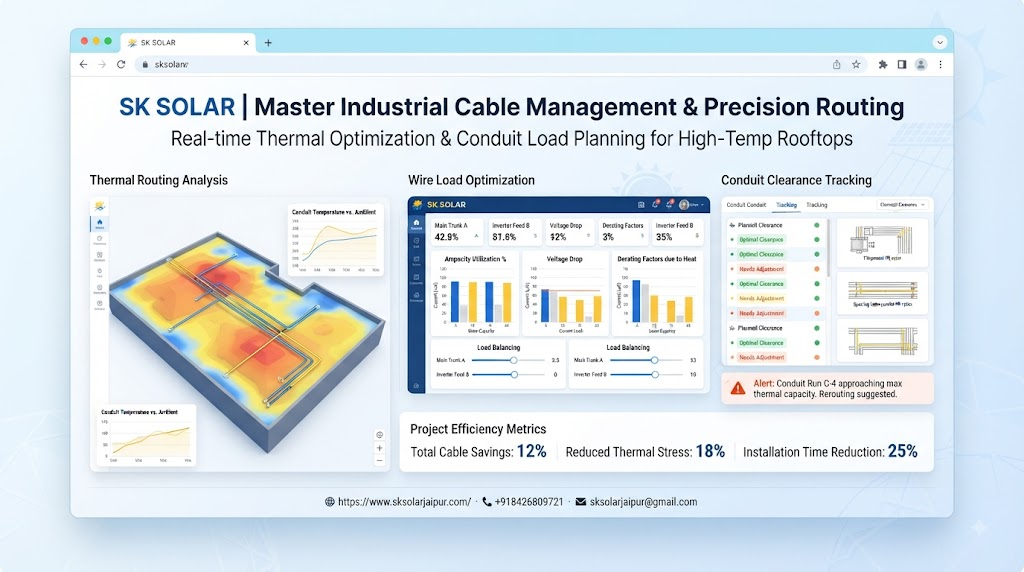
When business owners invest in commercial or industrial solar power, their eyes naturally gravitate toward the brand of the solar panels and the efficiency rating of the string inverters. That makes complete sense. However, the operational success and 25-year durability of a megawatt-scale solar installation depend just as heavily on something far less glamorous: the physical wire management and electrical conduit routing hidden beneath the arrays.
Without meticulous electrical planning, even the highest tier-1 solar panels can suffer from performance degradation, thermal hotspots, and micro-faults. Here is an inside look at how professional solar EPC execution handles the critical infrastructure behind the panels.
The Thermal Reality of Industrial Rooftops
Operating solar assets in regions with intense summer temperatures presents unique physical hurdles. Metal roofs and concrete slabs absorb massive amounts of ambient heat, pushing ambient surface temperatures well past normal operating thresholds.
When electrical cables carry high DC voltages from strings of panels down to the inverters under these conditions, standard cables left unshielded or poorly routed will experience resistance losses and accelerated jacket decay. Professional EPC execution requires elevated cable trays, UV-resistant dual-insulated DC cables, and dedicated air gaps that allow natural convection currents to cool the wiring harness continuously.
Separation of DC and AC Pathways
A common shortcut in substandard installations involves running direct current and alternating current lines in shared conduits or cramped raceways. This practice introduces electromagnetic interference and severely compromises safety during maintenance windows.
Master electricians approach layout design with strict segregation rules. High-voltage DC lines from the solar array are routed through specialized conduits into weather-proof combiner boxes, separated entirely from low-voltage control lines and output AC pathways leading to the AC Distribution Panels. Every junction point is torque-tested and sealed against moisture, dust, and rodent interference.
Earthing Integrity and Lightning Protection
An industrial solar array acts as a massive conductive surface elevated in an open environment. Without an industrial-grade earthing network and dedicated surge protection devices, a single lightning strike or severe grid fluctuation can fry expensive inverters and monitoring hardware.
Robust earthing materials—including hot-dip galvanized strips, chemical earthing electrodes, and dedicated copper bus bars—must be tied directly into the building structural ground. This creates a low-resistance path to safely dissipate transient voltages instantly.
My Take on Industrial Solar Wiring
If you are evaluating bids for a factory or warehouse solar project, do not just look at the price per watt of the panels. Ask your EPC provider about their cable specifications, conduit gauge, and junction box IP ratings. Skimping on balance-of-system hardware saves a fraction upfront but guarantees costly downtime down the road. Go with a trusted partner like SK Solar that treats wiring with the same engineering rigor as the generation assets themselves.
🌐 https://www.sksolarjaipur.com/ · 📞 +918426809721 · 📧 sksolarjaipur@gmail.com