Blog
the role of copper-bonded earthing rods and surge protection devices (SPDs) in safeguarding solar arrays against rajasthan lightning strikes
17 Aug 2026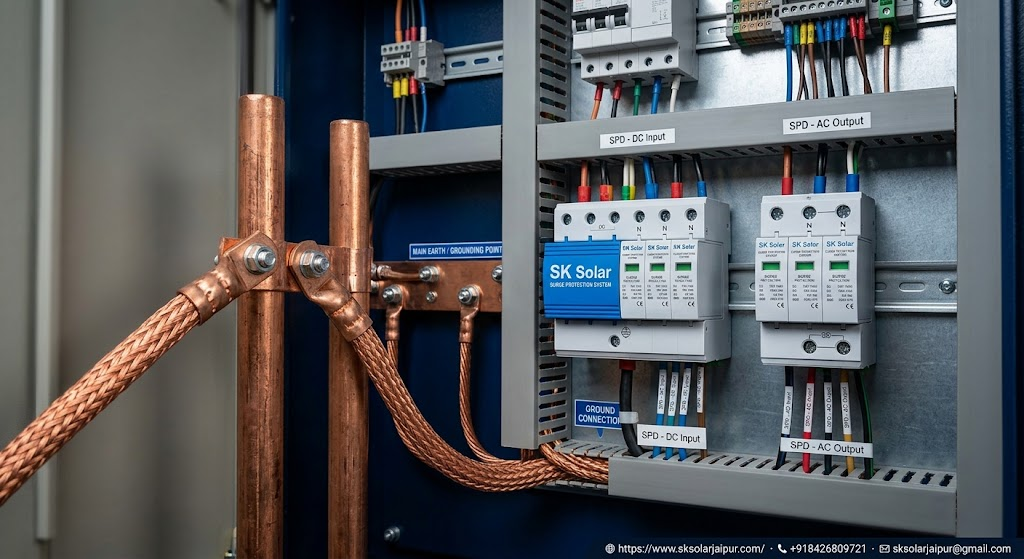
Beyond the Panels: Why Earthing and Surge Protection Define a Reliable Solar Installation
When most people think of a solar power system, their minds immediately picture sleek photovoltaic panels gleaming under the sun. However, the true longevity and safety of a solar array depend heavily on the components you cannot easily see—specifically, the electrical grounding and surge protection infrastructure.
In regions like Rajasthan, where seasonal electrical storms and high ambient temperatures are common, safeguarding sensitive electronics from voltage transients is critical. At SK Solar, we treat electrical safety with uncompromising precision during every EPC execution.
The Critical Role of Copper-Bonded Earthing Earthing provides a safe, low-resistance path for fault currents and lightning strikes to dissipate harmlessly into the earth. Standard iron rods degrade rapidly due to soil corrosion. SK Solar exclusively deploys high-grade copper-bonded earthing rods that offer superior corrosion resistance and consistent conductivity over decades, ensuring the structural frame and inverter chassis remain at zero potential.
Mitigating Transients With Advanced SPDs Voltage spikes caused by nearby lightning strikes or grid fluctuations can instantly fry expensive string inverters and monitoring hardware. Our installations incorporate industrial-grade Surge Protection Devices (SPDs) on both DC (solar side) and AC (grid side) circuits. These devices clamp dangerous overvoltages within nanoseconds, diverting excess energy safely away from your core equipment.
Professional Execution Matters Precision conduit routing, secure DC bus bar wiring, and rigorous earth-pit resistance testing are hallmarks of SK Solar's master electricians. When you invest in solar, you are investing in peace of mind.
Secure your home, farm, or industry with resilient solar engineering today.
How earthing is checked
An earthing system is only as good as its measured resistance. Installers test the earth pit with an earth resistance tester after installation and should record the reading. Indian practice for earthing design and testing is set out in IS 3043 (Code of Practice for Earthing), which explains electrode types, soil resistivity and measurement methods. Dry, sandy soils common in parts of Rajasthan have higher resistivity, so pits may need more depth, more electrodes or backfill compounds to reach a low, stable value. Ask for the measured value at handover and have it re-checked periodically, especially before the monsoon.
DC and AC surge protection
Surge protective devices for photovoltaic systems are tested and classified under IEC 61643-31 (DC side) and IEC 61643-11 (AC side). On the DC side, the SPD must be rated for the maximum open-circuit voltage of the string, which rises in cold weather, and is usually installed in the array junction box or at the inverter input. On the AC side, an SPD protects the inverter and building wiring from grid-borne surges. SPDs wear out after absorbing surges, so check the status indicator window during routine maintenance and replace cartridges that show a fault.
Lightning protection is a separate system
Earthing and SPDs are not the same as a lightning protection system. Where a building needs protection against direct strikes, air terminals and down conductors are designed using a risk assessment under IS/IEC 62305. Solar modules and mounting structures should be bonded into the building's earthing arrangement and kept at a suitable separation distance from lightning conductors, following the designer's calculations.
Questions to ask your installer
Which earthing standard and electrode type will be used, and how many pits? What earth resistance value will be measured at handover? Where will DC and AC SPDs be installed, and what are their voltage and current ratings? Will the module frames and structure be bonded with a continuous equipotential conductor? Written answers make it easier to compare quotations on safety, not just price.
References
IS 3043: Code of Practice for Earthing (Bureau of Indian Standards). IEC 61643-31: Low-voltage surge protective devices for the DC side of photovoltaic installations. IEC 61643-11: SPDs connected to low-voltage power systems. IS/IEC 62305: Protection against lightning. Central Electricity Authority (Measures relating to Safety and Electric Supply) Regulations, 2023.
Call to Action: Get Solar Consultation
🌐 https://www.sksolarjaipur.com/ · 📞 +918426809721 · 📧 dinesh@designanddevelopment.in